📐 Crosswind chart
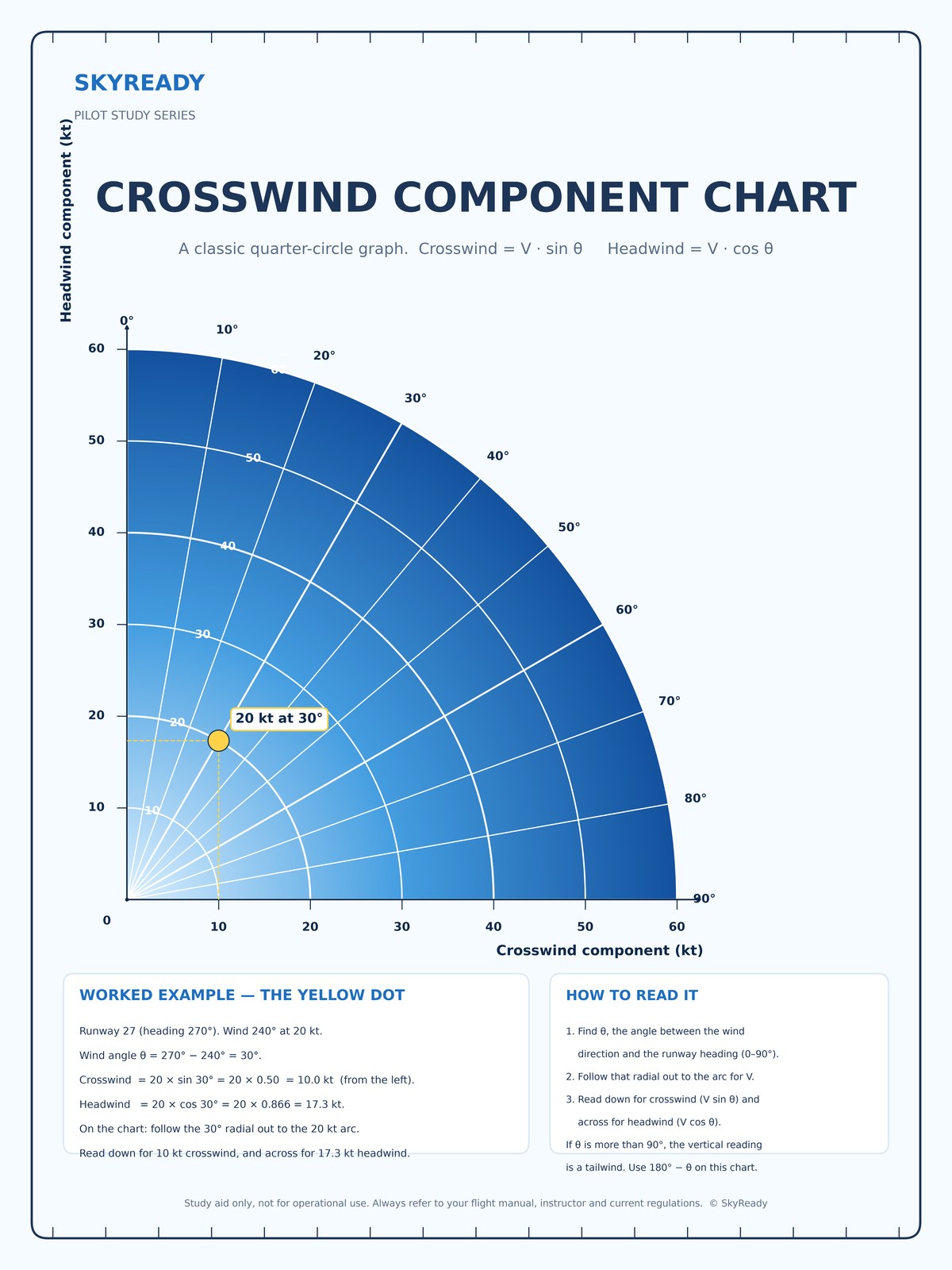
Drag the wind arrow around the runway to change the direction, and drag it in or out to change the speed. Watch the crosswind, headwind or tailwind, and which side it comes from. The quarter-circle chart on the right is the same graph as the printable poster.
Runway number is the heading ÷ 10, rounded. The runway on the picture stays pointing up, and is labelled with the number you pick.
Enter the figure from your aircraft's flight manual. This is only an example starting number, not a real type. If the live crosswind goes above it, you'll see a warning.
What's going on?
🌱 New to this? Start from zero
Wind direction is where the wind blows from. A wind of 240° comes from 240°.
Wind angle is how far that direction is off the runway heading. Runway 27 points to 270°, so a 240° wind is 30° off.
Crosswind is the part across the runway: V × sin θ. Headwind is the part on the nose: V × cos θ. If the angle is more than 90°, that vertical part is a tailwind.
Which side? If the wind direction is to the right of the runway heading (for example, runway 36 and wind from 030°), the crosswind is from the right. The other way, it's from the left.
Maximum demonstrated crosswind is the largest crosswind the manufacturer has shown in testing. It is not always a legal limit, but it is the figure students are taught to respect. Use the number in your own flight manual.
Study aid only, not for operational use. Example figures for learning only. Fixed Wing Exam Prep is built to help you pass, but results vary. Not affiliated with CASA, the UK CAA or the FAA.